Why a Wild Whale Shark is the Only One Worth Seeing
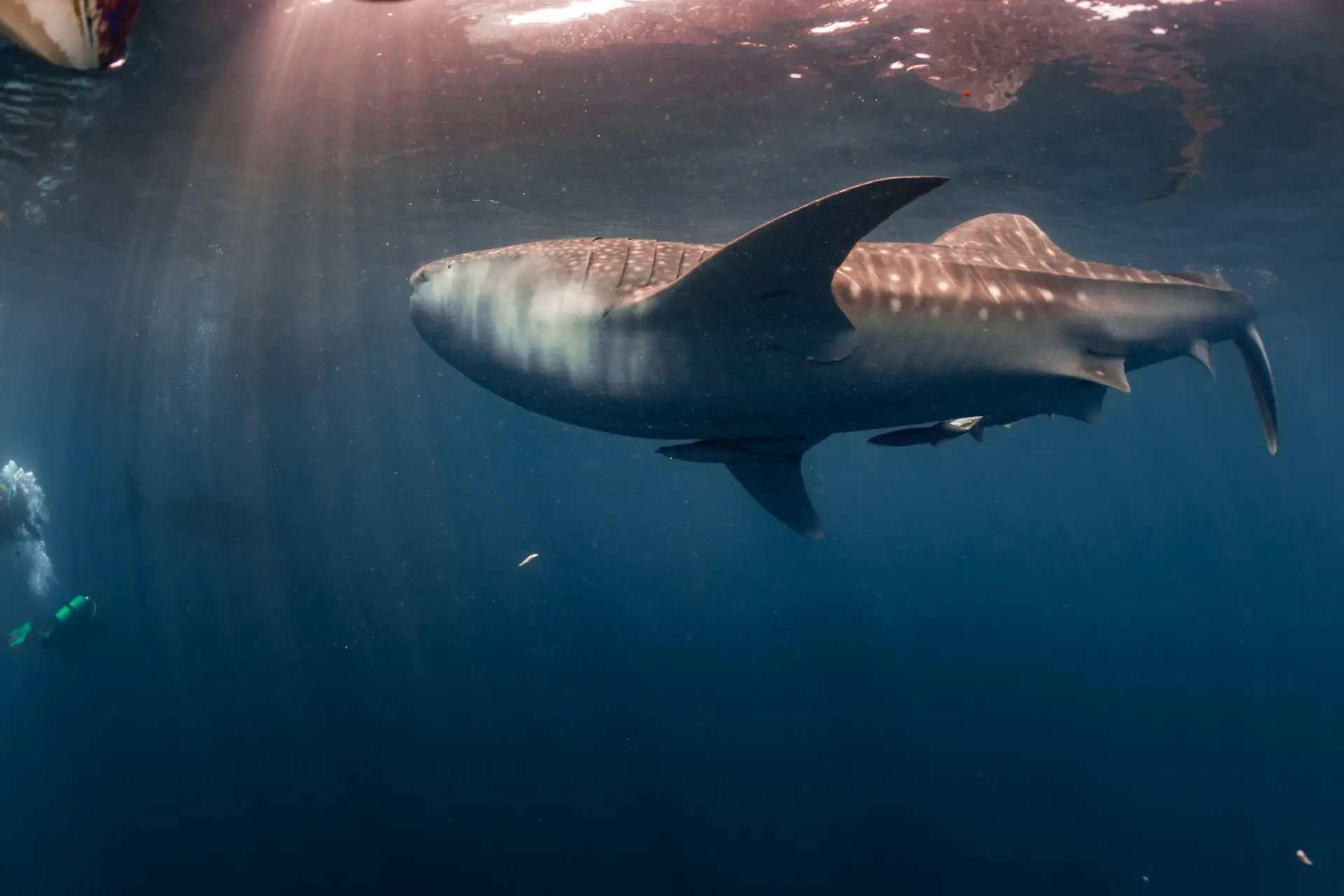
It appears from the deep blue like a living constellation, a silent, celestial body gliding through the water. Its skin, a tapestry of white spots and lines on a canvas of grey, is as unique as a human fingerprint. This is the whale shark (Rhincodon typus), the largest fish in our oceans—a gentle, filter-feeding giant whose immense size is matched only by its grace. To share the water with such a creature is a profound privilege, a bucket-list dream for travelers and divers the world over.
But our intense fascination with these animals has led us to an ethical crossroads. As whale shark tourism has boomed, a deep and contentious divide has emerged, splitting communities, conservationists, and tourists alike. The debate hinges on one simple, yet profoundly impactful question: should we feed them to guarantee a sighting? The answer determines not only the quality of our experience but the very future of this endangered species. While the lure of a guaranteed encounter is strong, a closer look reveals that the practice of feeding whale sharks comes at a devastating cost, and the only truly magical encounter is one that is entirely wild.
The Rise of the Underwater Circus
In certain coastal corners of the world, whale shark tourism has been transformed into a highly efficient, commercialized machine. The most famous—and controversial—example is the small town of Oslob in the Philippines. Here, what was once a quiet fishing village is now a bustling hub where hundreds of tourists line up each morning. The system is simple: local boatmen paddle tourists a short distance from shore, where other fishermen are actively hand-feeding whale sharks with buckets of krill.
The sharks, now conditioned residents, circle the boats from dawn until noon, their cavernous mouths agape, waiting for their daily handout. For the tourist, the sighting is 100% guaranteed. The photos are easy to get. On the surface, it appears to be a success story. It has provided a significant and reliable source of income for a community that previously had few options, effectively giving each shark a powerful economic value that protects it from being hunted. But this surface-level success masks a deep, ecological tragedy. This isn’t a wildlife encounter; it’s a spectacle. And the stars of the show are paying the price. It’s not all doom and gloom. A short distance away, the Bohol area of the Philippines has recently banned whale shark feeding and responsible dive shops are enjoying natural whale shark encounters.
The True Cost of a “Free” Meal
When we choose to feed a wild animal of this scale, we are not helping it; we are fundamentally altering its existence. The consequences are severe and far-reaching.
1. Erasing a Million Years of Instinct: Whale sharks are one of the planet’s great travelers. Tagging studies have shown them undertaking epic migrations spanning thousands of kilometers across entire oceans. These journeys are not random; they are driven by ancient instincts to follow seasonal plankton blooms, find mates, and give birth in safe locations. This travel is essential for maintaining genetic diversity and the overall health of the global population.
Feeding operations bring this to a grinding halt. Why would a shark expend enormous energy to migrate across the Pacific when a free, all-you-can-eat buffet is served daily in the same spot? The sharks in provisioning sites become sedentary. They abandon their natural foraging behaviors and their vital migratory routes. They are no longer wild animals fulfilling their ecological role, but semi-captive performers tethered to a tourist schedule.
2. A Recipe for Poor Health: The daily diet of krill provided by tour operators is the equivalent of a human living on nothing but energy bars. While it provides calories, it lacks the full nutritional spectrum found in the diverse array of plankton, fish eggs, and small crustaceans that make up their natural diet. Marine biologists have raised serious concerns about the long-term health implications of this nutritional deficiency.
Furthermore, the environment itself becomes hazardous. The constant crush of boats and snorkelers means the sharks suffer from numerous physical injuries. Studies have documented a high incidence of propeller scars, boat-strike abrasions, and skin infections on the sharks in these crowded feeding zones. They spend unnatural amounts of time at the surface, exposed to high levels of UV radiation, which can damage their skin and eyes.
3. Conditioning for Danger: Perhaps the most dangerous consequence is habituation. The sharks learn to associate boats and humans directly with food. This is a lesson that can get them killed. When they inevitably roam outside the protected tourist area, this learned behavior makes them dangerously bold. They may approach fishing vessels expecting a handout, only to be met by a poacher’s hook or a ship’s propeller. A wild shark’s natural caution is its best defense; we are systematically stripping them of it for a photograph.
The Authentic Thrill of the Wild
Contrast the chaotic scene of a feeding frenzy with the magic of a truly wild encounter. In places that have built their tourism model on respect and patience, the experience is worlds apart. In destinations from Western Australia to the quiet shores of Bohol, the guiding principle is observation without interference.
Here, the encounter happens on nature’s terms. It begins with a knowledgeable guide spotting the tell-tale signs of a shark feeding naturally on a plankton bloom at the surface. The boat approaches slowly, engines are cut, and swimmers slip into the water quietly, keeping a respectful distance. There is no scrum, no chasing, no feeding.
There is only the profound, heart-stopping moment when a creature the size of a school bus materializes out of the blue, gliding serenely through the water, completely indifferent to your presence. It is a moment of pure, unscripted grace. It might last for thirty minutes or thirty seconds, but its value is immeasurable because it is real. The thrill comes not from a guarantee, but from the privilege of being allowed a brief window into the animal’s natural life. This is the experience that fosters true appreciation and a genuine desire to protect these animals.
Your Choice Matters
As a traveler, you hold immense power. The choices you make, the tours you book, and the dollars you spend directly shape the future of whale shark tourism. You can be a customer demanding a product, or a conservationist supporting a principle.
Before you book, ask the hard questions. Does the operator have a strict no-feeding policy? Do they enforce a code of conduct regarding distance and interaction? Is there an educational component to the tour? Does a portion of their proceeds go back into local conservation?
Choosing the wild encounter over the manufactured one may require more patience. It may not come with a 100% guarantee. But the reward is infinitely greater. It is the reward of knowing that your presence did no harm. It is the reward of an authentic memory that will last a lifetime. And it is the reward of contributing to a future where these gentle, spotted giants can continue their cosmic dance across our oceans, wild and free.
The Pura Vida Encounter: Our Commitment in Costa Rica
The principles of ethical, non-interference tourism discussed above are not just abstract ideals; they are the bedrock of our operations here in Costa Rica. At Rocket Frog Divers, we are privileged to explore one of the most biodiverse marine environments on the planet, and with that privilege comes a profound responsibility to protect it. Our philosophy is simple: we are guests in the ocean’s kingdom, and we act accordingly.
This commitment is never more apparent than during those magical, unexpected encounters with whale sharks. We are fortunate that the rich waters of Costa Rica’s Pacific coast are part of the natural migratory route for these gentle giants. We sometimes encounter them at the legendary Bat Islands, amid the vibrant reefs of the Catalina Islands, or even in the protected waters of the Gulf de Papagayo.
Crucially, these are always encounters on the shark’s terms. We never use bait, we never attempt to feed them, and we never alter their natural course. Our team is trained to read the situation, to approach with caution and respect, and to give the animal the space it deserves. We cut the engines, observe from a respectful distance, and allow our divers to witness a truly wild creature behaving naturally.
We can’t promise you a whale shark sighting. There are no schedules or guarantees when it comes to wild nature. They may grace us with their presence for an hour, or offer just a fleeting glimpse as they glide back into the deep blue. And that unpredictability is precisely what makes the moment so precious. It’s a gift, not a transaction.
When you dive with us, you are choosing to support a model that prioritizes the long-term health of the ocean over a short-term, manufactured thrill. You are investing in the belief that the most profound moments are not the ones we orchestrate, but the ones nature chooses to share with us. So when you explore the incredible sites of Guanacaste, keep your eyes on the blue. You never know when the ocean’s largest, most gentle resident might just swim by to say hello.